Integrity Watch in the Western Balkans and Türkiye
In several Balkan countries and Turkey, civil society needed better tools to identify patterns of political corruption risk and translate large volumes of dispersed information into useful inputs for investigation, reporting, and advocacy. The challenge was especially complex because corruption is not expressed or measured the same in all contexts: some countries had more developed databases, while in others the available information was more limited and fragmented.
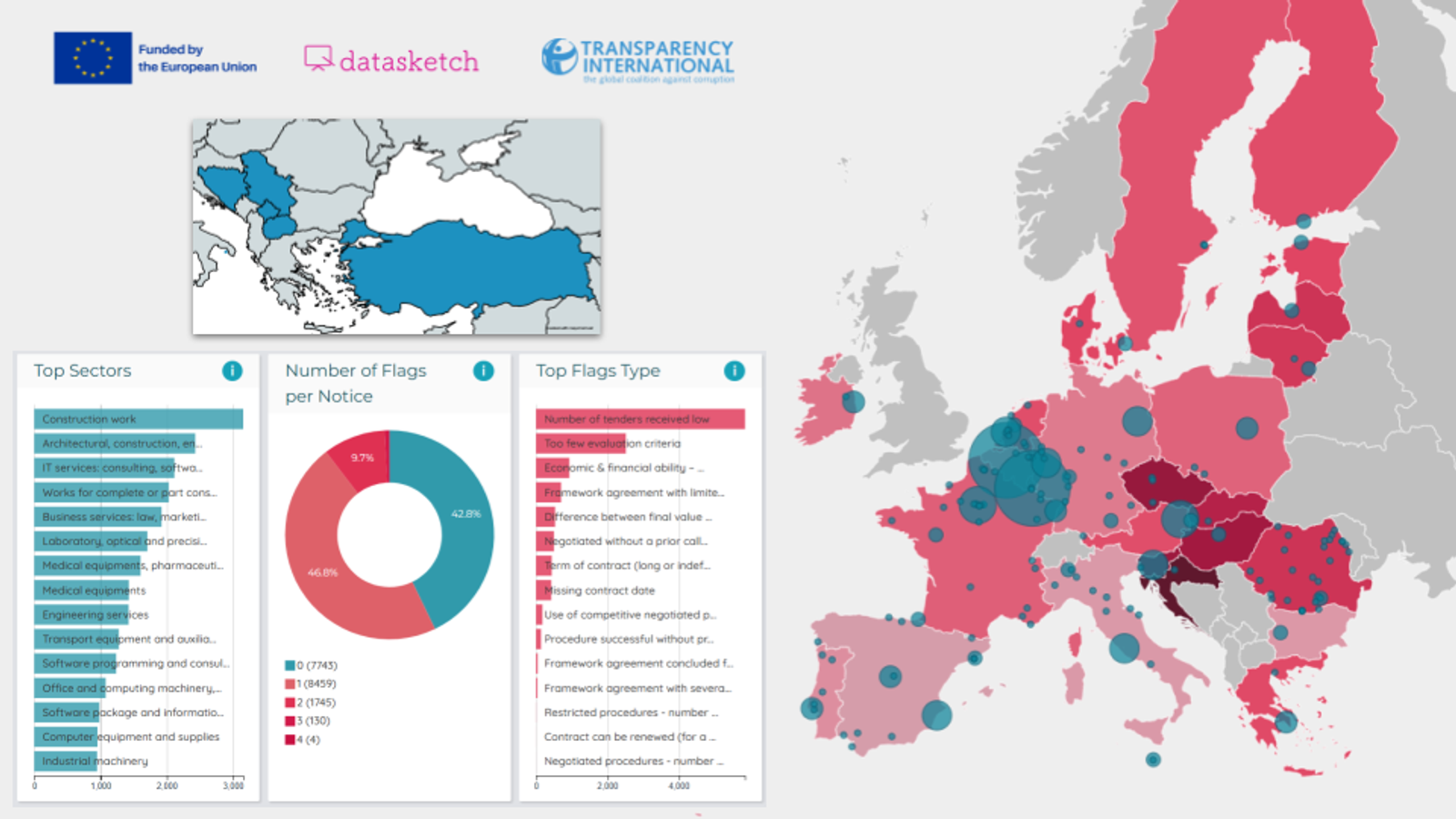
We developed a collaborative process with civil society organizations from each country, led by the national chapters of Transparency International, to identify needs, build corruption risk indicators, and define what signals should be visualized. Based on this, we crossed multiple databases in five different languages to develop a visualization dashboard that allowed for monitoring risks, detecting patterns, and generating alerts usable by civil society to deepen investigations and make reports.
We designed a work process with civil society to build corruption risk indicators and converted them into a useful dashboard to monitor, investigate, and activate alerts in different national contexts.
The project allowed for the construction of a monitoring system that was more useful and sensitive to the context for civil society actors in five countries. The tool facilitated a comparative reading of risks and the generation of alerts to support more focused reporting, follow-up, and investigation processes.